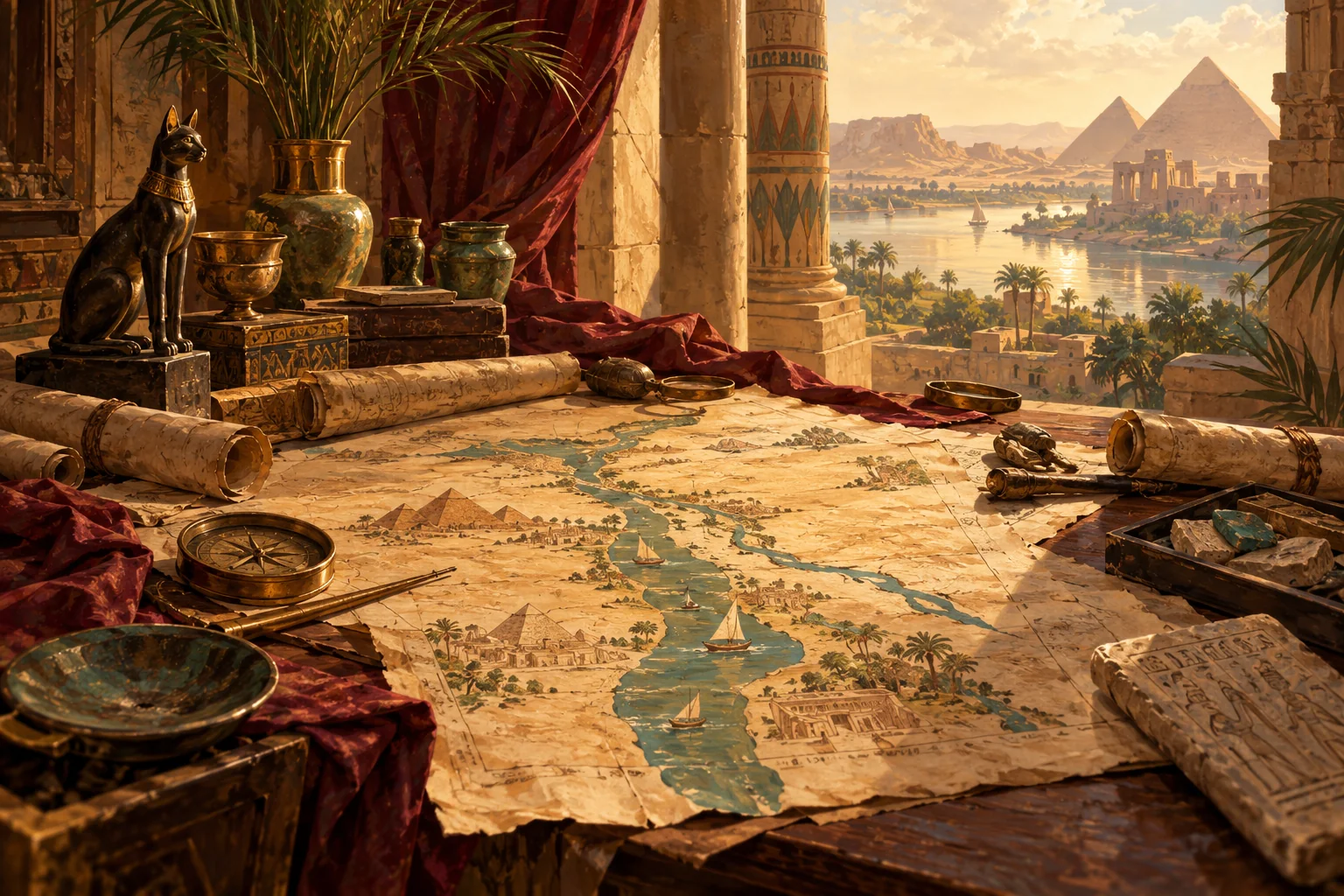
Egypt and France are useful coordinates for approaching Robert Solé, but “between two cultures” is only a starting phrase. It does not explain the different work done by language, family memory, professional life, historical research, or a monument transported from one country to another. A more useful reading asks what crosses, who carries it, and what changes along the way.
This essay proposes four routes through that question: language, movement, objects, and narrative form. The framework is editorial interpretation. It is grounded in the documented subjects of selected books, but it does not claim that every novel makes the same argument or that Solé’s biography determines the meaning of his work. The purpose is to make comparisons more precise.
Language is more than a location
A book written in French about Egypt cannot be understood simply by assigning the language to one side and the subject to another. Language is also a means of education, memory, social exchange, and literary form. To examine its role in a novel, ask when it becomes visible. Is a language named, translated, explained, or treated as the unmarked medium of a conversation?
Those choices may affect a reader’s sense of familiarity. A term left unexplained can invite inference; an explanatory aside can establish distance; a translated expression can make an encounter readable while changing its texture. None of these techniques has one automatic meaning. Their effect depends on who is speaking, who is listening, and how the narrative positions its audience.
A useful comparison selects two passages with different assumptions about the reader’s knowledge. Do they offer the same amount of explanation? If not, what does that difference allow? This approach avoids the vague claim that a writer simply “builds bridges.” It asks how particular sentences manage understanding and where they preserve something that remains unfamiliar.
Movement is not always the same experience
Migration, travel, correspondence, return, and historical transport all involve movement, but they create different relationships to place. A traveler may expect to leave again; a migrant may be building an everyday life; a returning person may compare the present with a remembered world. Treating these as one universal experience of displacement can erase the choices and constraints that distinguish them.
Use a route diagram with three questions at each stage: why does the movement happen, what is carried, and what cannot be carried? The answer may concern possessions, language, status, relationships, or expectations. Keep the list tied to the text. An attractive metaphor about “carrying home” becomes stronger when you can show what the phrase describes in a specific passage.
Mazag and Le Tarbouche offer different starting premises for such a comparison: a life organized through social favors in France, and a family narrative associated with Egypt. That contrast can generate questions about how relationships are made and inherited. It should not become a claim that one country represents freedom and the other tradition. The people and situations are more particular than that opposition.
Objects acquire new surroundings
An object can make a cultural relationship visible without reducing it to a meeting between two abstract nations. Solé’s nonfiction Le Grand Voyage de l’obélisque and his novel Les Méandres du Nil provide a particularly concrete pairing. The latter is a 2019 novel connected with the journey of the Luxor obelisk. The former approaches the journey as historical nonfiction.
The Musée national de la Marine’s account records the monument’s transfer from Luxor toward Paris, including the river and sea stages. Its present setting is the result of a sequence of practical and political acts. For a reader, the central interpretive question is what a change of setting makes newly visible or easier to forget.
An object displayed far from its original surroundings can acquire additional associations. Those associations need not erase its earlier history, but they can redirect attention. Ask what a description foregrounds: age, workmanship, engineering, diplomacy, spectacle, or place. A comparative reading can track the choices without pretending that the object has one uncontested meaning wherever it stands.
Cultural interest and unequal power
A history of fascination is not automatically a history of equal exchange. L’Égypte, passion française offers a documented starting point for the subject of French interest in Egypt. A reader should ask who has the resources to travel, collect, publish, translate, and define what counts as knowledge. Interest can produce careful study while remaining connected to unequal power.
The BnF’s presentation of the Description de l’Égypte is useful here. It places scientific work within the military expedition and notes the coexistence of precise documentation with some fanciful reconstructions. That combination resists an easy verdict. A record can preserve valuable information and still reflect the assumptions, ambitions, and limitations of those who made it.
For a practical source comparison, take a visual plate and its caption together. What does the caption claim to identify? What has the image selected or reconstructed? What would you need to verify before treating it as direct documentation? The same questions apply to a literary description, though the genre changes what kind of factual promise is being made.
The aim is to develop a reading capable of recognizing both achievement and constraint. Celebrating a cultural connection without examining its conditions is incomplete; dismissing every observation solely because of those conditions is also too simple. The specific evidence should determine how the two are related in each case.
Compare forms, not just themes
A novel, a newspaper column, and a historical account can address related subjects while asking for different kinds of trust. Fiction may construct a scene and a private consciousness. Journalism must justify factual assertions about the world. Historical nonfiction organizes surviving evidence while acknowledging what it cannot establish. The presence of one author’s name does not make these contracts identical.
Choose a limited feature for comparison: an opening scene, an explanation of a place, a claim about motive, or an ending. Ask what evidence each form supplies and what it expects from the reader. An imagined thought in a novel should not be cited as a fact about a historical person; a concise column should not be judged as if it promised the documentation of a scholarly monograph.
This comparison can illuminate continuity without erasing difference. A writer may return to questions of place or memory across forms, yet the way those questions become readable can change substantially. Demonstrating that change is more useful than repeating that all the books are “about identity.” A theme becomes analytically valuable when it helps explain a decision in the writing.
A reading project you can actually finish
Choose one novel and one nonfiction work, then define a question narrow enough to follow. For example: how does each book describe arrival, how does an object introduce a historical relationship, or how is unfamiliar information explained? Read with that question in view, but record passages that resist it. A comparison should be able to change direction when the evidence does.
Keep a small source record with the edition, page, observation, and interpretation in separate fields. The observation should describe what is on the page. The interpretation should explain why you think it matters. Separating them makes revision easier and helps prevent a compelling argument from quietly losing contact with its evidence.
For the fictional route, begin with Le Tarbouche or Mazag. For nonfiction, use the Egyptian history book guide to choose a scale that suits your question. You do not need a complete survey of the bibliography before making a thoughtful comparison.
Egypt and France remain useful coordinates when they direct attention toward particular relationships. They become less useful when they stand in for everything a character is or everything a book does. Read for the people, institutions, words, and objects that make the connection concrete. That approach leaves room for cultural attachment, conflict, curiosity, and change without deciding in advance which one must dominate.
Sources & reading
- Institut du monde arabe — L’Égypte, passion française
- Princeton University Library — Les Méandres du Nil
- Musée national de la Marine — Luxor/Paris obelisk history
- BnF — The Description of Egypt
- Gallimard Numérique — Mazag
- Points — Le Tarbouche
Bibliographic details and the short premise are sourced above. Reading questions and interpretive suggestions are editorial proposals, not quotations or claims of the author’s intention.